|
Barre, Montpelier firefighters get life-saving carbon monoxide testing device
|
|
|
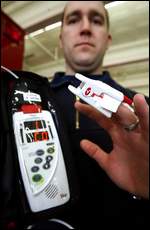 By David Delcore Times Argus Staff MONTPELIER – In a move that may save money – and potentially lives – firefighters in Barre and Montpelier have acquired a device that can quickly measure the level of carbon monoxide in the blood. By David Delcore Times Argus Staff MONTPELIER – In a move that may save money – and potentially lives – firefighters in Barre and Montpelier have acquired a device that can quickly measure the level of carbon monoxide in the blood.
The latest additions to their respective arsenals of equipment – called a "Rad-57 Pulse CO-Oximeters" – were purchased with the help of a 50-percent matching grant offered by the Professional Firefighters of Vermont.
During a press conference at the Montpelier Fire Station on Friday, Matt Vinci, president of that statewide organization, suggested the cutting-edge equipment would be an invaluable tool for the two departments and the communities they serve.
"Carbon monoxide is the … deadliest poisonous gas we face on a regular basis," Vinci said, explaining firefighters are exposed to carbon monoxide at structure fires and carbon monoxide leaks.
"It turns into almost a routine daily response to us," he said.
According to Vinci, that exposure can contribute to cardiac problems, which are a leading cause of fatalities among firefighters who die in the line of duty. Over 50 percent of firefighter deaths each year are attributed to heart attacks, he said.
Although the devices typically cost about $4,000, Vinci said he was able to secure a "group rate" of $3,500 for his organization's 12 member departments. He said several departments – including those in Rutland, St. Johnsbury, Burlington and South Burlington – have already taken advantage of the 50 percent matching grant, and in coming months he expects Barre Town EMS and the fire departments in Springfield and Bellows Falls to follow suit.
"We feel strongly that this is something that every fire department should have," he said.
Montpelier Fire Chief Gesualdo Schneider agreed.
"This is a quantum leap in terms of caring for the public and caring for our own," he said of a device that was recently deployed to monitor firefighters' carbon monoxide levels dur-ing the "controlled burn" of the former moose club in Barre.
Although Schneider said ensuring the safety of his men was a key consideration when he decided to include money for the new piece of equipment in his budget, he explained all patients served by the city's ambulance department will be checked with the non-invasive device as a precaution.
Barre Firefighter Matt Cetin said while budgetary constraints prevented the city from providing the matching funds needed to leverage the purchase, the local union, of which he is president, felt so strongly that it agreed to tap its own funds to come up with the $1,750.
"This is something the community had to have, so we went forward on our own to purchase it," he said. "It's a technology that can save lives."
The portable device uses multiple wavelengths of light to instantly measure the level of carbon monoxide levels in a person's blood without breaking the skin or drawing blood.
Prolonged exposure to low levels of carbon monoxide have been shown to cause long-term heart, brain and organ damage. The long-term effects of carbon monoxide poisoning can include cardiac arrests, Parkinson-like syndromes affecting motor skills and speech, dementia, cortical blindness, acute renal failure, and muscle cell death.
|
|
|